Water-bearing pellet stove or RIKA MULTIAIR?
Anyone looking into modern pellet stoves will sooner or later come across different ways of distributing the heat generated throughout the home. One of these is the water-bearing pellet stove: it transfers a large proportion of its heat to the heating water, making it part of the central heating system. Another option is to distribute warm air directly to specific additional rooms – for example with RIKA MULTIAIR. But which system is the better fit?
The answer depends primarily on what you want to achieve with the pellet stove. Should the stove be integrated into the home’s central heat supply? Or is the main goal to use the heat from the stove not only in the room where it is installed, but also in one or two additional living spaces?
This is precisely where a water-bearing pellet stove and a pellet stove with RIKA MULTIAIR differ fundamentally in their concept.
What is a water-bearing pellet stove?
A water-bearing pellet stove is a pellet stove that, in addition to providing heat to the room where it is installed, transfers a large proportion of its heat to the heating water.
The heated water is then fed into the home’s heating system and, depending on the respective system concept, can for example:
- supply radiators
- support underfloor heating
- supplement the existing central heating system
- contribute to domestic hot water preparation
The pellet stove thus becomes part of the central heat supply system. Whether and which additional components are required depends on the respective stove, the existing heating system and the specific system concept.
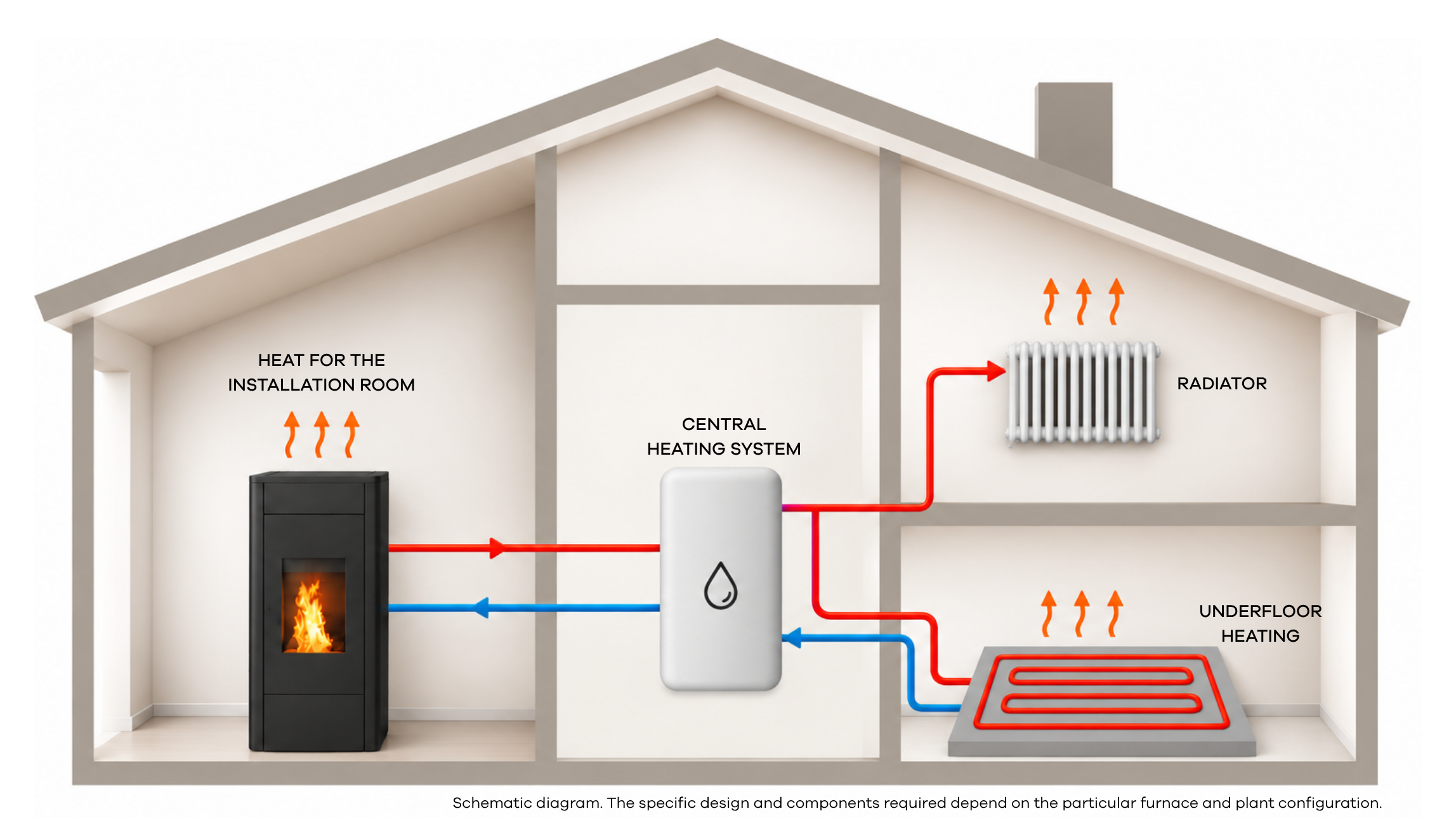
How does a water-bearing pellet stove work?
As with a conventional pellet stove, the pellets are automatically fed into the combustion chamber and burned. The resulting heat is then distributed to different areas.
Part of the heat is released directly into the air in the room where the stove is installed. Another, usually larger proportion is transferred to the heating water. This is then transported via the existing heating system to the respective consumers.
This means that the heat from the pellet stove can be used not only in the room where it is installed, but becomes part of the building’s central heat supply. However, integration into a water-based heating system also means that the specific planning must be coordinated with the existing heating system.
When can a water-bearing pellet stove make sense?
A water-bearing pellet stove can be particularly interesting if the stove is deliberately intended to form part of the central heat supply. Correct dimensioning is important in this context. The heating output should be based on the building’s actual heat demand. Particularly in well-insulated or energy-efficient homes, this can be significantly lower than expected. A heat load calculation can help to realistically determine the required output. Dimensioning based solely on the living area, on the other hand, provides only limited information.
Integration into the heating system: What needs to be considered?
The specific installation of a water-bearing pellet stove depends on the appliance used and the existing heating system. Depending on the system concept, additional components may be required, such as:
- buffer storage tank
- pumps or pump groups
- expansion and safety equipment
- control technology
- hydraulic connections
In addition to the technical components, coordination between the different trades involved also plays a role. Planning and installation must be compatible with the existing heating system and carried out professionally.
The key point is this: a water-bearing pellet stove is a solution designed for integration into a heating system. This may be exactly the approach you are looking for – but it is not necessary for every household.
Another option: Directing heat to specific rooms
Many people interested in a pellet stove have different requirements. For example, they want to:
- heat the living area with pleasant stove warmth
- use the heat in adjacent rooms as well
- operate the existing heating system independently of the pellet stove
- keep installation work to a minimum
For these requirements, RIKA offers a suitable solution with MULTIAIR.
What is RIKA MULTIAIR?
RIKA MULTIAIR is a warm-air distribution system for selected RIKA pellet and combi stove models. The convection air heated by the stove is directed through connecting pipes into up to two additional rooms. This creates a fundamentally different heat distribution concept and can be particularly interesting, for example, when the main living areas are located in adjacent rooms.

Heat distribution with RIKA MULTIAIR does not require hydraulic integration of the stove into the existing heating system. However, as already mentioned, when selecting the stove model, it is essential to ensure that the required heating output is appropriately matched to the application. As with the purchase of any individual room heating appliance, the general conditions at the intended installation site should be considered together with your specialist dealer and chimney sweep and adapted where necessary.
Water-bearing or RIKA MULTIAIR – which concept is the better fit?
The two systems take different approaches. The decision should therefore not be based solely on the type of stove, but on the desired heating concept.
| Water-bearing water | RIKA MULTIAIR | |
Heat distribution | via heating water | via warm air |
| Integration | into the central heating system | no hydraulic integration into the central heating system; direct warm-air distribution instead |
| Objective | supporting the central heat supply | targeted heating of up to two additional rooms |
| Planning focus | coordination with the heating system | planning the spatial distribution of warm air |
Also available as a combi stove
RIKA MULTIAIR is also available for selected RIKA combi stove models. A combi stove combines two worlds with all their benefits: wood logs and pellets. This makes it possible to combine different heating habits and preferences – from convenient, automated pellet operation to traditional heating with wood logs.
Conclusion
A water-bearing pellet stove and a pellet stove with RIKA MULTIAIR are two different ways of using heat throughout the home. Which solution is the better fit depends on the individual living and heating situation as well as personal requirements.
The water-bearing option can make sense if the pellet stove is specifically intended to be integrated into the central heat supply. Depending on the system concept, it can support heating circuits and, where applicable, also contribute to domestic hot water preparation.
RIKA MULTIAIR takes a different approach: the heat is transported directly into up to two additional rooms via air ducts. This does not require hydraulic integration of the pellet stove into the central heating system. It is therefore particularly suitable when the aim is to use heat from the pellet stove not only in the room where it is installed, but also specifically in up to two additional rooms.