
Heating Cost Comparison
How to calculate your annual heating costs yourself.
Rising energy prices have brought the topic of heating into focus more than ever in recent years. Many households had to cope with sharply increasing costs, particularly during the energy crisis of 2022 and 2023. Although the situation has now stabilised again, the prices of many energy sources are still above the levels of previous years. At the same time, one thing remains certain: energy prices will continue to fluctuate in the future.
Anyone who knows their own heating costs and compares different energy sources can make more informed decisions – whether when changing their heating system or when planning their long-term energy costs.
Why do energy prices fluctuate?
The cost of heating energy is influenced by many factors:
- international crises and geopolitical developments
- supply and demand on global markets
- transport and logistics costs
- weather and seasonal demand
- political measures or CO₂ pricing
In addition, individual factors determine the actual heating demand:
- the condition and insulation of the building
- living area
- heating habits
- the efficiency of the heating system
For this reason, heating costs often vary considerably.
Calculate heating costs yourself – step by step
Using a simple example calculation, you can roughly calculate and compare your annual heating costs for different energy sources. The following calculation is based on standardised assumptions and provides a useful guide.
Step 1: Calculate your annual heating energy demand
Your living area serves as the starting point, from which the heated building volume can be calculated easily.
Assumptions:
- average room height: 2.60 m
- heated reference volume: 70% of the building volume*
- heating demand: 35 kWh per m³ per year**
*For the approximate calculation, it is assumed that around 70% of the building volume is actually heated. This takes into account that, in most houses, not all rooms are heated throughout the year or to the same extent.
**For the example calculation, an average heating demand of 35 kWh per m³ per year is assumed. This guideline value corresponds to a typical residential building and is intended solely for an approximate calculation. The actual heating demand depends, among other things, on the year of construction, insulation and heating habits. Depending on the building, the actual heating demand may therefore differ significantly. Passive houses and new buildings constructed to current standards, for example, are well below the stated value.
Example: Single-family house with 130 m² of living area
- Total building volume: 130 m² × 2.60 m = 338 m³
- Heated reference volume: 338 m³ × 0.70 = 236.6 m³
- Annual heating energy demand: 236.6 × 35 = 8,281 kWh per year
Step 2: Calculate your annual fuel consumption
To generate 35 kWh of heating energy, the following average amounts are required:
Energy source | Required quantity / consumption (per 35 kWh) |
Pellets | 7.3 kg |
Firewood (solid cubic metre) | 8.9 kg |
Heating oil | 3.3 l |
Natural gas | 3.4 m³ |
These standardised consumption values indicate the approximate amount of fuel required to generate 35 kWh of heat. They are based on the calorific values of the respective energy sources and typical system efficiencies.
Source: The stated values were calculated on the basis of data provided by the Austrian Environment Agency.
Formula: Heated reference volume × consumption value (per 35 kWh) = annual fuel consumption
Note: If the consumption values are given per kWh (rather than per 35 kWh), they are multiplied by the annual heating energy demand calculated in the first step.
For our example with a heated reference volume of 236.6 m³ (= heating energy demand of 8,281 kWh per year), this results approximately in:
Energy source | Annual consumption |
Pellets | approx. 1.727 t |
| Firewood | approx. 2,106 kg / 2.8 solid cubic metres / 6.67 stacked cubic metres* |
Heating oil | approx. 780.8 l |
Natural gas | approx. 804 m³ |
*Air-dried wood (up to 20% residual moisture) weighs around 700 to 750 kg per solid cubic metre for hardwood (such as beech or oak). In this case, this corresponds to approximately 2.8 solid cubic metres. One solid cubic metre of beech wood corresponds to a maximum of approximately 2.38 stacked cubic metres (1 m logs, cross-stacked; cf. TFZ) – the unit of volume on which the following price is based.

Step 3: Calculate your annual heating costs
The calculation is based on the following energy prices:
Energy source | Price |
Pellets | 388.01 € per tonne |
| Firewood | 130 € per stacked cubic metre |
Heating oil | 1.25 € per litre |
Natural gas | 1.66 € per m³ |
Formula: Annual consumption × current energy price = annual heating costs
Example (pellets): 1,727 t × 388,01 € = approx. 670 € heating costs per year
The same principle applies to heating oil, natural gas and firewood:
- Firewood: 867 €
- Heating oil: 976 €
- Natural gas: 1,335 €
Tip: Always use the latest average prices for your calculations, such as those provided here by proPellets Austria (for pellets, heating oil and natural gas) and by the Austrian Forestry Association (for firewood). As at: summer 2026
Note: This simplified calculation is intended solely as a guide and depends on the current energy prices. As mentioned above, actual energy consumption is influenced by factors including the condition of the building, the quality of its insulation, heating habits and the quality of the fuel.
What does the comparison show?
A comparison of heating costs like this is intended to evaluate different heating systems from an economic perspective. It also illustrates how differently price developments affect the various energy sources.
While fossil fuels such as natural gas and heating oil are often more strongly influenced by international markets and geopolitical developments, firewood and pellets are sourced predominantly from domestic timber processing. As a result, they are less dependent on international factors. In the long term, this can contribute to greater planning certainty.
Of course, the price of wood fuel can also fluctuate – for example, due to changes in supply and demand. Historically, however, these fluctuations have generally been smaller than those of fossil fuels.
How to reduce your heating costs in the long term
Regardless of the energy source you choose, there are several measures you can take to reduce your heating costs:
- Have your heating system serviced regularly
- Bleed your radiators
- Choose your room temperature consciously – reducing it by just 1 °C already saves energy
- Improve the building envelope and insulation
- Optimise your heating control settings
- Replace old heating systems with modern, efficient systems
Modern heating systems, in particular, operate much more efficiently than older systems and ensure economical fuel consumption while maintaining a high level of comfort.
Sustainability: More than just heating costs
When choosing a heating system, it is not only the purchase and operating costs that matter. Sustainability is also becoming increasingly important for many homeowners. Wood and pellets are renewable energy sources that are produced predominantly from regionally available raw materials or by-products of the timber processing industry. This eliminates long transport distances and ensures that much of the added value remains within the region. At the same time, only the amount of CO₂ that the tree absorbed during its growth is released during combustion. Combined with modern, low-emission heating appliances, wood and pellets therefore offer not only a cost-effective but, above all, a climate-friendly alternative to fossil fuels – combining sustainable heating with a high level of security of supply.
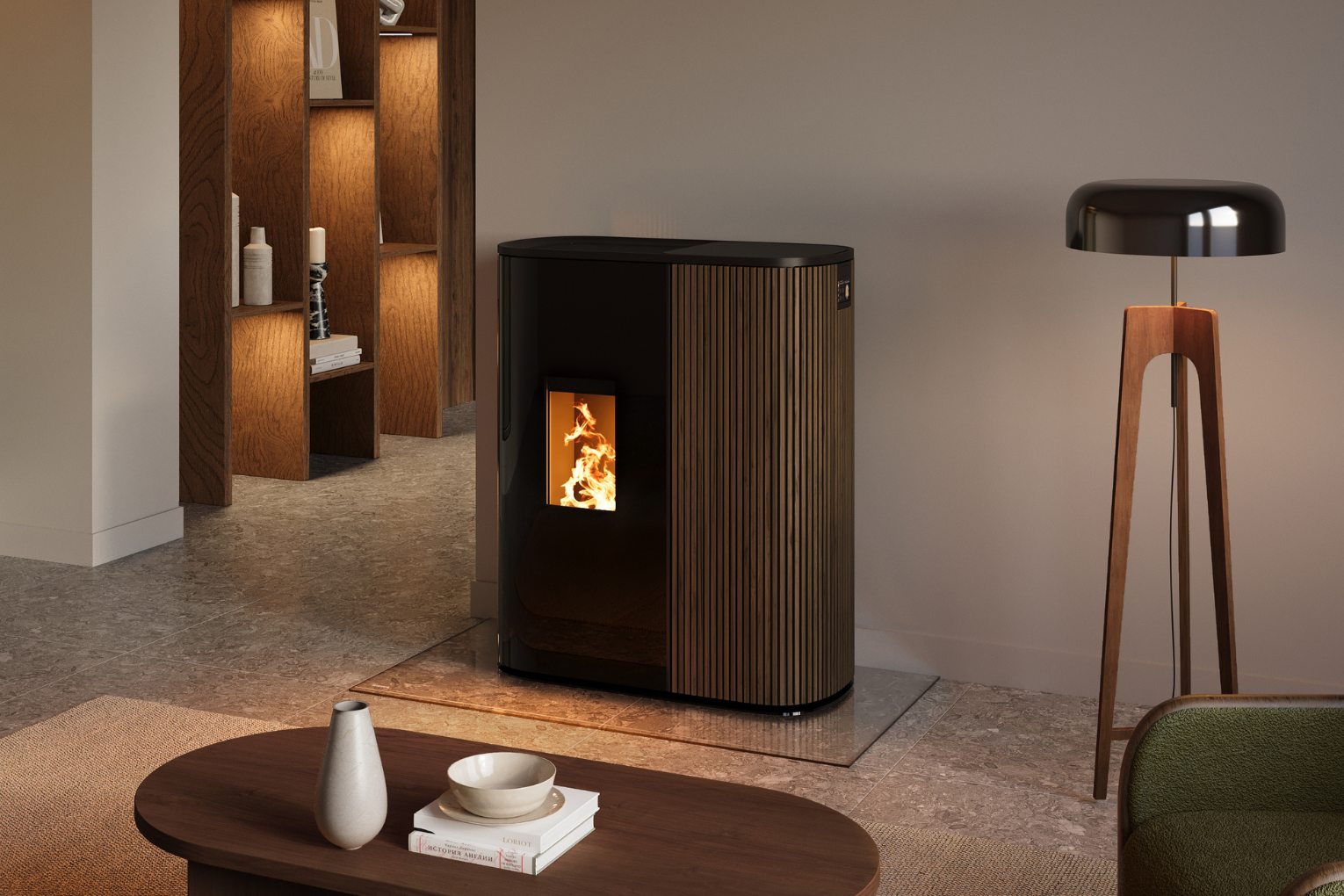
Individual stoves as a practical addition to any heating system
Whether you live in a new build, a renovated existing building or an older house: a modern individual stove can be a practical addition to almost any heating system. In well-insulated new buildings, the output of a woodburning or pellet stove is often sufficient to keep individual living areas comfortably warm during the transitional seasons without having to switch on the often slow-reacting central heating system. In existing buildings, a stove provides additional heat on particularly cold days and reduces the load on the main heating system. This can reduce the consumption – and therefore the cost – of gas, oil or electricity in the long term while at the same time increasing living comfort. Modern woodburning, pellet or combi stoves also offer a high level of operating convenience, often feature automatic output control, and can be integrated optimally into existing heating concepts. This gives homeowners greater flexibility and enables them to respond more calmly to rising energy prices.
Conclusion: Heating cost comparison
Even though the energy markets have stabilised again after the crisis, heating costs remain an important cost factor. Anyone who knows their own heating energy demand and regularly compares different energy sources has a good basis for making future decisions.
A simple approximate calculation makes it easy to determine annual heating costs. At the same time, it is worth considering long-term aspects such as security of supply, price developments, environmental factors and the efficiency of your own heating system. Modern pellet heating systems, for example, offer a sustainable alternative that combines renewable energy with a high level of comfort and comparatively good predictability of fuel costs. Supplementary heating systems such as a woodburning or pellet stove not only have a positive effect on the living atmosphere, but also represent a sustainable and practical addition from a cost perspective.


